
Wellness Has a Power Problem
A Herbalist’s Reflections on Wellness, Ideology, and the Loss of Nuance

What’s been unsettling me lately isn’t just one figure or one scandal— it’s the pattern.
As the Epstein files continue to roll out, Deepak Chopra’s name surfaces in private correspondence that feels wildly at odds with the persona he’s sold for decades. At the same time, we have Dr. Oz casually downplaying alcohol use as a “social lubricant,” measles outbreaks spreading across the country, and a federal health agenda that seems deeply confused about what preventive care actually looks like. Layer in RFK Jr.’s promise to “clean up” public health by tearing systems down rather than rebuilding them, and the throughline becomes hard to ignore.
These are not fringe voices. These are men who’ve been positioned culturally and politically as authorities on health, wisdom, and truth.
And yet, so much of what they represent is a distortion.
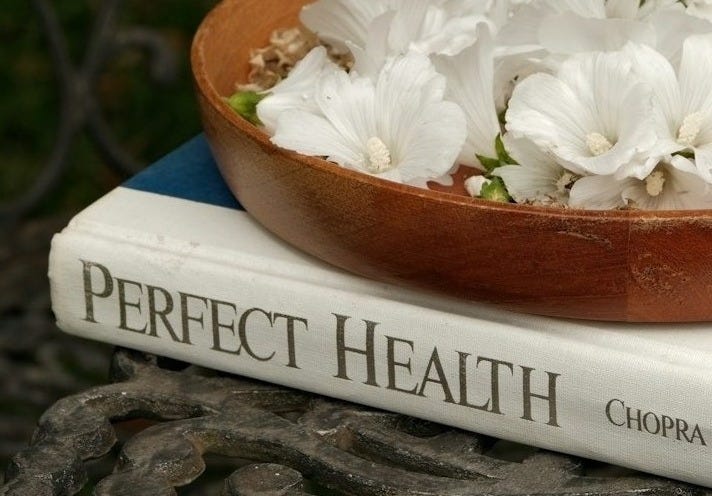
Take Chopra. Anyone who has actually studied or practiced Ayurveda knows there is no promise of perfect health embedded in that system. There’s no guru, no final state of enlightenment, no hack that overrides biology or consequence. Ayurveda, like Chinese medicine and traditional herbalism, is about balance, relationship, and ongoing participation. It’s slow. It’s individualized. It requires consistency and humility. The idea that ancient systems promised perfect health is a modern fabrication designed to sell books, programs, and authority.
Chopra isn’t an anomaly. He’s a symptom.
The same goes for the broader wellness culture orbiting these figures.
This isn’t organic trend drift. A lot of this is manufactured cultural signaling.
It’s also important to note that this isn’t just about individual influencers going rogue. Fringe political groups have gotten very good at seeding ideology through lifestyle, and wellness has become one of the easiest entry points. Health is intimate. It’s personal. And it’s often where people are most vulnerable.
And to be clear, this isn’t an attack on personal belief, spirituality, or cultural tradition. People are entitled to their own worldviews, religious practices, and healing systems—or none at all. Difference isn’t the problem. The problem begins when a belief system elevates itself as the way, when it shifts from something one practices into something others are expected to follow. When disagreement is framed as ignorance, illness, or obstruction, belief hardens into dogma.
Movements such as the tradwife trend often present as harmless “natural living” on the surface: raw milk, sourdough, herbal remedies, and homemaking aesthetics. But woven gently and artfully into those feeds are deeper messages: submissiveness framed as virtue, rigid gender roles, biblical homeschooling, and deeply conservative political values. It’s not shouted. But it’s normalized. And it becomes part of a daily routine before it ever feels like ideology.
On the other end of the spectrum, the same pattern shows up in gym-bro wellness culture. Hyper-masculinity gets framed as discipline. Misogyny is repackaged as “biological truth.” Feminism is blamed for social decline. Strong, independent women are painted as unnatural or threatening. Specific male figures are elevated as “elites”—not because they’re ethical or grounded, but because they project dominance. Again, it’s not just fitness advice. It’s their worldview slipped in under the guise of health.
What’s striking is how much of this borrows language from ancient traditions while stripping them of context, humility, and restraint. These systems were never about domination, purity, or rigid identity. They were about balance, relationship, and responsibility. They emphasized moderation, discernment, and long-term harmony with the body and the land. Often practiced communally, not obsessively at the individual level. What we’re seeing now isn’t tradition. It’s the rebranding of ancient ideas and concepts hollowed out and sold back to us with a fee attached.
This isn’t confined to one political direction. These dynamics show up everywhere. On the “right”, it might look like tradwife wellness or hyper-masculine biohacking. On the “left”, it often shows up as spiritual bypassing, nervous-system absolutism, or wellness spaces that quietly suggest illness is a personal failure of mindset, trauma work, or embodiment. The language changes a bit. Liberation instead of purity, or regulation instead of discipline— but the underlying structure is essentially the same.
In every case, nuance and complexity get flattened. Systems disappear. Structural harm becomes individualized. Care turns into performance. Because each of these spaces functions as its own closed ecosystem, being an outlier and asking questions, expressing doubt, or refusing full alignment can feel like betrayal.
What makes this especially painful is that most people aren’t looking for ideology; they’re looking for connection. Humans are wired for belonging. When we feel anchored to a group, our nervous system settles. When we feel socially threatened, we go into threat response: fight, flight, freeze, or appease. That’s why these spaces can feel addictive: they offer immediate relief from ambiguity, loneliness, and the low-grade panic of modern life.
And in a world where institutions have lost credibility, and the future feels unstable, certainty becomes its own sedative. A rigid narrative, however flawed, can feel safer than an honest “I don’t know.” Group identity gives people a script: who’s good, who’s bad, what to eat, what to fear, what to blame, what to buy, how to be. The algorithm reinforces it by rewarding conviction over complexity, and that repetition starts to feel like truth.
Social media is the machine that makes all of this possible. It’s an echo chamber optimized for repetition and certainty, run by people who understand exactly how to keep their finger on the cultural pulse. And when you’re sick, disillusioned, burned out, or failed by existing systems, certainty can feel like relief.

And all of this quietly assumes a version of life most people don’t actually have.
It assumes time to biohack, research, cook each meal from scratch, get adequate sleep, and optimize every aspect of their life. It assumes money for supplements, protocols, organic food, and selfcare. It assumes a body that isn’t already stretched thin by chronic stress, illness, caregiving, enviromental conditions, or survival.
For many people, reality looks very different. We’re working long hours just to get by. Food is expensive. Sleep is fragmented. People are raising kids, caring for family, juggling jobs, and navigating an insurance system that’s costly, confusing, and often too inadequate to provide them the care they truly need.
Wellness should not be a moral hierarchy or a political Trojan horse. It is not a partisan issue. It should be a shared right that is supported at both the personal and collective level. Real health comes from access, safety, nourishment, rest, and systems that function to care and provide for the people living inside them.
I am pro-herbalism. I am pro-plant. I am pro-medicine. I am pro-spirituality. But I am deeply wary of anyone who sells certainty, perfection, or purification, especially when it’s disconnected from systems of care and collective responsibility for this earth and each other.
There are no gurus. There are no shortcuts. And there is no version of health that doesn’t ask us to tend both the body and the world it lives in.
This is such a sharp and necessary reflection, Cait. I really appreciate how you name the loss of nuance and the way wellness gets used to smuggle certainty and ideology instead of care. The reminder that real health is about access, balance, and systems, not gurus or perfection, landed hard.